Showing posts with label Reviews. Show all posts

Thursday, February 7, 2019

Total Effort

By the end, tears were rolling down my face.  As I finished the last chapter of Shoe Dog, an autobiographical account of the creation of Nike by one of its co-founders, Phil Knight, I felt that I had re-lived the entire journey with him.  Everybody has heard of Nike, of course, but Phil Knight is almost a mystery man when measured against how much we know about the legendary founders of other famous companies. The same could probably be said of the story of Nike itself.  Why did I find the story so compelling? Perhaps the fact that Phil Knight was an avid runner created a connection right away.  Or perhaps it was that the story is set in the world of sports and the luminous talents that Nike is associated with.  Ultimately, a passage in the book itself suggested the answer, but more on that later.

For most of us, Nike is about its athletes.  Everything about the brand seems to be inextricably linked with the stable of transcendent sporting talents that they have sponsored over the years. So, it came as a surprise to read in Shoe Dog that Phil Knight didn't really care to pay athletes to endorse Nike products and had to be practically forced to do so.  I normally steer clear of  "celebrity" autobiographies.  For one, I am suspicious of their motives (mostly feels like a vanity project), but more pertinently, I wonder what I would gain from them.  But, I got Shoe Dog as a birthday gift and one day, for some reason, I picked it up and started reading it.  And, I couldn't put it down.

The history of Nike, as reported by its founder, reads like an exciting thriller - all manner of twists and turns, near-death experiences, high adrenaline risk, tragedy, and triumph.  Phil Knight did have a ghost writer, but I felt that it his voice coming through loud and clear in the book.  His words and actions (as outlined in the book) seem completely consistent with the personality that emerges from the book - one does not get the sense that he is sugar coating or air brushing anything.  He is (famously) guarded about this personal life (although the important stuff is there), but he doesn't hold back on any aspect that is related to Nike. 

What comes through shining brightly is the focus and strength of belief one has to have to create something like Nike.  Today, their success seems inevitable, but that was hardly the case for the vast majority of their existence.  Over and over again, Phil Knight (& early members of his team) had to fight the odds just to stay afloat.  When we look at a big success (or failure) from the remove of time or space, we tend to see only the large contours.  But, to truly appreciate what it took - one has to see all the little wrinkles and the accretion of small layers that led to the edifice.  Only by noticing the details can we appreciate the all-consuming passion and effort that it takes to create a Nike.

I had carried around this vague notion that it was the "Be Like Mike" campaign with Michael Jordan that really launched Nike as a world wide brand and I was waiting eagerly for the chapter where Phil Knight would surely talk about partnering with some of the greatest athletes of our time - Jordan, Tiger, Kobe, Federer, LeBron.  But instead, the athlete that he talks about most was Steve Prefontaine (or "Pre" as he was more commonly known) - the middle distance track athlete from Oregon. Nike couldn't officially sponsor Pre since he would have lost his amateur status, so they "hired" him as an employee.  Pre was a household name in Oregon right around the time that Nike was trying to break into the big time and Knight dwells in some detail about their relationship and how Pre inspired him (& Nike).  The story ends in tragedy, though - Pre died in a car accident at the age of 24.  He was driving the MG convertible that he had bought with his first Nike "salary."

Knight closes the book talking about another personal tragedy and it is here that he finally mentions how much some of those famous athletes mentioned above mean to him.  Once again, I was struck by how unexpected the relationships were - they were less about the endorsement deals and more about the personal connection he had with each of these athletes.  This chapter really resonated with me - perhaps because many of these athletes have loomed large in my own sports fandom.  His loyalty to "his" athletes is unswerving and it doesn't seem to have a lot to do with their on-field success. He describes how Tiger Woods was the first one to call him during his (Phil's) personal tragedy and goes on to add, "And I will never stand for a bad word spoken about Tiger in my presence." My eyes welled up re-reading that now, as they did several months ago when I read them for the first time.

I rarely mark passages in books because, for me, writing anything in a book is tantamount to defacing it, but I had to make an exception with this one.  Phil Knight has a way of distilling his thoughts into really powerful passages that immediately resonated with me.  As a life long sports fan, I have spent many, many, hours watching, reading, and generally obsessing about sports.  Rarely did I feel this time was wasted and, in fact, feel sympathy for people who do not (or cannot) appreciate sports.  However, I have never been able to satisfactorily capture why this is so. This passage from Shoe Dog does it for me:
"This, I decided, this is what sports are, what they can do.  Like books, sports give people a sense of having lived other lives, of taking part in other people's victories.  And defeats. When sports are at their best, the spirit of the fan merges with the spirit of the athlete, and in that convergence, in that transference, is the oneness that the mystics talk about."

Watching Pre run a race in his trademark all-out style, Phil Knight muses about what made Pre such a compelling athlete to watch.  He suggests that, "No matter the sport - no matter the human endeavor, really - total effort will win people's heart."  That actually does a pretty nice job of capturing why Phil Knight's story had such an impact on me. 

Monday, October 28, 2013

"The Storm of War"

It took me as almost long as the event itself - OK, not quite, but I started it well over a year ago and yesterday, I finally finished it! As is obvious from the photo above, The Storm of War is a single-volume history of the Second World War.  It was published in England in 2009 (where the author, Andrew Roberts, is from) and in the US in 2011. The paperback edition came out last year.

At over 600 pages (of the tall variety, at that), it is not a quick read, but it sure is a fascinating one.  The Second World War doesn't get a lot of coverage in Indian history books (although Indian soldiers participated in significant numbers as part of the British forces, the war itself never entered India) and before reading this book, I only had the most rudimentary awareness of this cataclysmic event. I have considered others books in the past (& even own a couple of them), but I am certainly glad that this is the one I chose to actually read.

Andrew Roberts has the rare ability to synthesize such a vast and complex story into a readable narrative that does not feel superficial or mired in inane detail. He has marshaled an impressive array of sources (the Bibliography alone runs to over 25 pages) and quotes them at just the right moment.  His approach is to break up the war into its various theatres and cover each one for time periods that span a few years at a time.  This implies that he jumps back in time between chapters, but it allows him to keep the focus on one specific aspect of the war in a particular chapter.  In general, this approach works quite well, although it could be a mite confusing if you take too many long breaks.

I obviously learnt a lot from this book, but probably the most astonishing fact for me was amount of lives lost by the Russians.  If America paid for the war (literally) in arms, equipment, and food, then it was Russia that paid the price in blood.  Some of the statistics that surround this are truly startling: 50 million lives were lost in this war. Of this more than 27 million were from Russia.  The Germans were engaged simultaneously on Eastern (Russia) and Western (Britain and USA) fronts. The Western front with the War of Britain and the D-Day landings gets most of the press, but the real bitter, bloody, and often hand-to-hand, battle was fought on the Eastern front. Of every 5 Germans killed on the battlefield, 4 were killed on the Eastern front.

Roberts doesn't just report history - he also provides analysis and insight.  He does this throughout the book, but particularly so in the last chapter ("Conclusion") where he provides his answer to the question, Why did the Allied forces win the war? It is clear that there was nothing inevitable about this victory and the author points out the long series of strategic and tactical blunders on the part of Hitler that likely cost Germany the war.  Germany held the advantage for much of the early going - indeed, the author makes a strong claim for the German soldier to be the "best" soldier in all of the Word War.  Ultimately, the seeds for the downfall of the Nazis were within the same philosophy that brought them to power and triggered the war in the first place.

A book of this scope must necessarily drop some aspects that others might consider very important. There is barely any mention of Mussolini and while the Japanese side of the story gets considerably more play (especially the attack on Pearl Harbor and of course the dropping of the nuclear bombs), the presentation is almost entirely from Hitler's perspective.  As the author readily admits, this is by design and due to the somewhat obvious fact that Hitler was the primary reason for starting the war, the early successes for the Axis, and their eventual defeat.

The combined leadership of Roosevelt, Churchill, and Stalin won the war for the Allies, but while Stalin essentially ruled as a dictator, Roosevelt and Churchill presided over a more fractious set of generals with out-sized egos that constantly squabbled over matters of strategy and tactics. It is interesting that their "committee style" approach eventually triumphed over the "single vision" approach of Germany.

Almost 70 years after the end of the war, it is hard to imagine what it must have been like to live through that tumultuous time, but the accretion of the descriptions of one bloody battle after other, the cruelty of one people against another (& indeed, sometimes on their own - especially in the case of the Russians), and just the massive loss of life and survival in horrendous conditions cannot fail to weigh down the reader and indeed, the lingering sense I had as I finished the book was one of sadness.

Is there justification for the enormous cost (in lives and treasure) of this war? The author posits the theory that Germany needed to lose the war as comprehensively as it did to usher in the peaceful country it has since become and avoid the rise of revanchist forces. This debate was of course the central question of the Bhagvad Gita and it is generally accepted that Krishna's view of "duty first" is the preeminent one - implicitly in the way events transpire in the Mahabharata and more explicitly by a long line of more modern philosophers.  However, as Amartya Sen discusses in The Argumentative Indian, Arjun's questioning of the morality of the cost that such duty entails still deserves consideration - but that is a subject for another day.

One last statistic about the war that reflects on the relative costs borne by the Allies: The US spent $350 billion - more than Britain and the USSR combined, but for every American life lost in the war, Russia lost 92.

Tuesday, April 5, 2011

An Expert In Remembering

OK, try to memorize this list: "Picked Garlic, Cottage Cheese, Peat Smoked Salmon, Six bottles of white wine, Three pairs of cotton socks, Three Hula-hoops, Snorkel, Dry Ice machine, Email to Sophia, Skin toned cat suit, DVD of Paul Newman's Somebody Up There Likes Me, Elk Sausages, Directors Chair, Rope and Harness, Barometer."

Done? Good, we'll get back to it in a moment. First, a bit more about its source: Its from the new book, "Moonwalking With Einstein: The Art and Science of Remembering Everything," by Joshua Foer. The book really has nothing to do with either moonwalking or Einstein, but is instead about developing a good memory. There is some discussion of technique, but it is more of a socialogical study of how the value of a good memory has changed through human history.  For this discussion the author uses the context of the US Memory Championships- which he first discovers as a journalist and then as a (very successful) contestant. This is in similar vein to Stephen Fatsis' journey into the world of competitive Scrabble in "Word Freak."

Entertaining though is the description of the competition, the training, and many of the main characters, I think the book has a couple of more important points to make. The first is about the value of a good memory and actually placing significant emphasis on developing one. For most of history, a good memory was one of the most valued skills that a person could have. Then came all the ways of making "external" memories: paper, printing, and now of course, the Internet. Over the last century or so, most progressive thinkers in Western education have rubbished the value of remembering things/facts, while emphasizing creative thought and comprehension. But, are the two really incompatible? The author makes a strong case for re-emphasizing memorization as part of regular schooling- in his telling, memory and intellect are really two sides of the same coin.  I am already looking for the 'Kumon' of memorization - I suppose some would argue that the Indian education system would fit the bill nicely!

The second point is about the benefit of "Deliberate Practice." This will be familiar to those who have read "Talent Is Overrated" by Geoffrey Colvin, whose central thesis is the same thing. In both cases, the authors are quoting the research results of Dr. Anders Ericsson of Florida State University who has explored this in multiple research studies. He (like many others in his field) has not found any evidence of "raw talent" and the best indicator of success/excellence is what he has called, Deliberate Practice. It is the notion that while practice may make perfect, not just any practice will - you have to focus on specific skills to practice and then do them over and over, almost ad nauseum.  Once again, this has great significance to how we approach education and schooling. The Kumon approach to math and reading are perfect examples of this approach.

The author covers a rather wide and diverse territory - maybe a bit too scattershot to be a truly gripping book. His description of memory techniques were all new to me - specifically, the use of "memory palaces."  The insight here is that the human brain has an amazing memory for images and more specifically for recalling what was in a particular place, as long as you remember the place itself. More importantly, the author tries hard to make the point that very few (if any at all) are "born" with a great memory - it is a skill that can be developed with hard work and with the right techniques. There is no such thing as a "photographic memory."

This brings us back to the rather eclectic list that I started this blog off with: Memorizing that list is an exercise that the author has the reader do and I dutifully followed his instructions.  That was more than three weeks ago and when I started to type this blog, I was able to reproduce it exactly from my memory.

Friday, February 4, 2011

"The Worst Journey In The World"


Antartica can safely lay claim to being the most inhospitable continent, with temperatures falling as low as -115F in Winter. But for much of the 19th century it continued to attract a number of sea faring explorers - because it housed a coveted prize in exploration: the South Pole. On January 17, 1912 the British navy captain, Robert Scott and his 4-man team reached the South Pole. However, they were not the first to get there - that distinction belonged to Roald Amundsen and his Norwegian team: they had beaten Scott to the Pole by 33 days. But, for the better part of the last 100 years, it has been Scott who has been celebrated as a hero while Amundsen has been largely forgotten outside his native Norway.  Behind this apparent contradiction is a very simple human truth: People glorify a noble failure far more than a (seemingly) facile success. You see, Scott and his team did not make it back alive: the last three members of the team perished on March 19, 1912 after being trapped in a blizzard and unable to get to their next depot of food and fuel - a mere 11 miles away.  The circumstances of their death and the stoicism with which they faced the inevitable (as inferred from the diaries they left behind) dove tailed perfectly with the British ideal of the heroic amateur explorer, who would accept any hardship and sacrifice for his comrades and his country and Scott became an instant hero around the world.

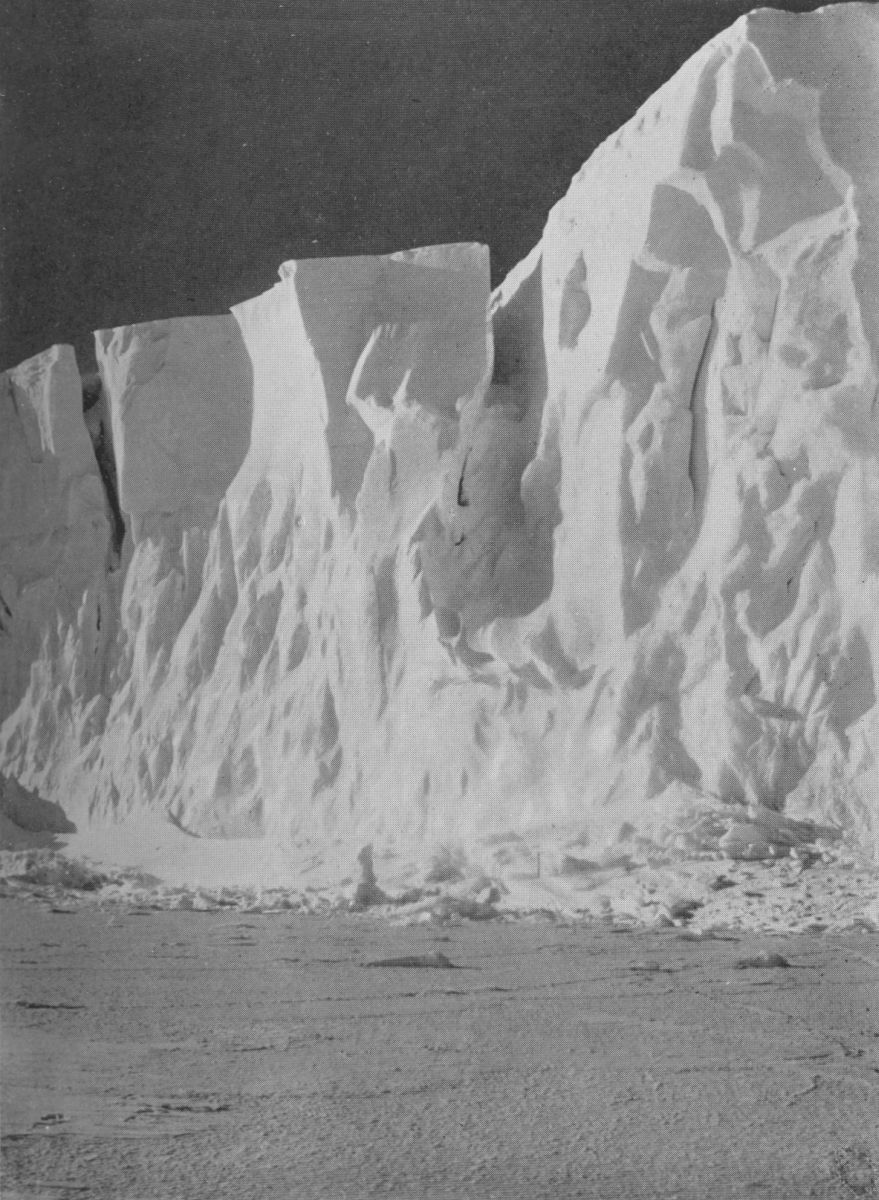
It took me a while, but I eventually got through the 600 page tome, "The Worst Journey In The World," by Aspley Cherry-Garrard.  The book describes Scott's second Antartic expedition (also called the Terra Nova Expedition after the name of his supply ship) which was from 1910 to 1913. Cherry-Garrard was the youngest member of the expedition - just 20 years old when he set out and with no real qualfications for being on the expedition. In fact, he is almost ruled out for medical reasons - he was severely short-sighted and needed thick glasses to see anything. Agreeing to go on the planned 'Winter Journey' (see later) is what gets him on the team. However, by sheer hard work and a good attitude he becomes a valued member of the team.  After years of answering questions about what happened during the trip, Cherry-Garrard gave in and wrote his masterpiece (the only book he would ever write) and it was published in 1922.  Almost 90 years later it continues to attract new readers and stir the imagination of almost everybody who reads it. Pretty remarkable for a book that devotes long sections to scientific observation about the local flora and fauna and is filled with archaic turns of phrase and lots of jargon - both nautical and geographical.

Attempting to summarize the trip here is hardly possible - I highly recommend the Wikipedia entry about the Terra Nova expedition for that - it is well written and thoroughly annotated. However, it helps know the broad outlines: At the dawn of the 20th century, both the Poles were as yet unconquered despite several fierce attempts to do so. Admiral Peary of the US would claim to the North Pole in 1909 (a claim that is largely discounted today), but the South Pole was still up for grabs when Scott and his team departed from England in mid-1910. The plan was to get to Antartica in early Summer (remember that Summer in the southern hemisphere is from Dec-March) and establish camp. They would then spend the rest of the Summer and early Fall laying depots (stores of food and fuel) along the chosen route to the Pole that they would depend on for the assault on the Pole the following (1911) Summer. They would wait out the intervening winter months (June-Aug of 1911) at their base camp (in a place called 'Cape Evans').  Antartica is barely hospitable in Summer, it has near impossible conditions in Winter - super low temperatures, howling blizzards, and of course no sunlight - and nobody had ever contemplated any kind of travel during those months. Until this expedition.

Camping in a Blizzard (sketch by Wilson)
On 27th June, 1911 - in the dead of the Antartica winter - 3 men headed out  to Cape Crozier, which was 60 miles from Cape Evans, on the eastern edge of Ross Island. The three men were Dr. Wilson (the leader), Bowers, and our author, Aspley Cherry-Garrard. The goal was to visit a rookery of the Emperor Penguin in order to collect some eggs which are laid in the middle of Winter.  Wilson (a zoologist) had a theory that examining the egg of an Emperor penguin (considered a primitive bird) would yeild clues about some missing evolutionary links. This was a most horrific journey - they really didn't know what to expect and things turned out far worse than anybody imagined. It was often pitch dark (they held up a candle to see each other and their way) and bitterly cold - temperatures were almost always around the -60s and one day dropped all the way to -79F. It was so cold that their clothes would freeze into boards within seconds of coming out of their tent and in the night they lay shaking in their sleeping bags, as Cherry-Garrard writes, "..until our backs would almost break." During the day their perspiration and breath would instantly freeze into ice and during the night their sleeping bag would be soaking wet as all this ice melted. They were "man-hauling", which means that they were pulling a sled with their supplies. And in their case, it was actually 2 sleds carrying almost 800 lbs of stuff. The surface condidtions were often very rough - sometimes almost sand-like because of the extremely low humidity.  Many days they covered a little over a mile after 10 hours of pulling and it took them 19 days to cover the 60 miles. Things only get worse after they reach Cape Crozier, but somehow they survive and actually return with 3 penguin eggs.
This trip is in fact the "worst journey" of the title of the book (and not the subsequent Polar Journey during which Scott and his team perish).  You know that the three men survived this trip, but you can scarcely believe it as you read page after page of the terrible conditions and deteriorating health of the travelers in Cherry-Garrard's matter-of-fact prose.  In fact, they come close to death many times but somehow pull through. Rather than discounting from the impact, the almost lack of poetry or overwrought text gives the telling a weight that is hard to shake off. The sheer accretion of detail - there is a detailed accounting of almost every single day of the 6-week journey - gives you sense of being immersed in the journey yourself and it is easy to envision yourself in the middle of a vast icy expanse - damp, cold, and miserable in the dark. Although you are well aware of it by now, you can't help but be moved when Cherry-Garrard says, almost in passing, that his two companions, Bowers and Wilson, survived the "worst journey in the world" only to die a few months later during the ostensibly well-planned Polar Journey.

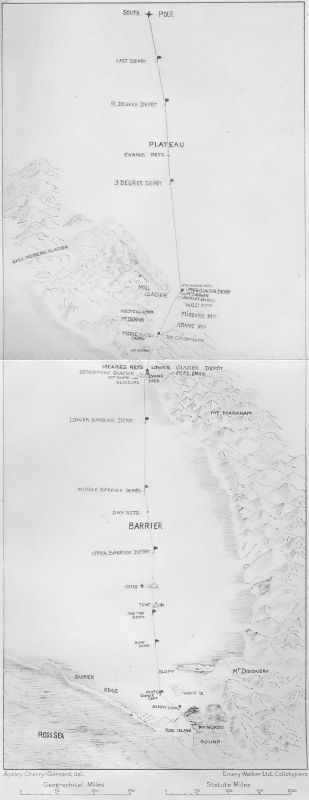
The Polar Journey—Apsley Cherry-Garrard, del. Emery Walker Ltd., Collotypers.
Map of the Polar Journey
Cherry-Garrard gives much the same thorough treatment to the rest of the expedition and of course the starring role is occupied by the actual assault on the Pole and the subsequent discovery of the remains of the 5-man Pole party. The difficulty of going to the Pole and back is hard to exaggerate - they had to cover 1712 miles, almost entirely on foot and often pulling a sled laden with their gear and food.  They set out on November 1, 1911 and for most of the next 5 months they walked and man-hauled for 10-15 miles, every single day (except when trapped by blizzards).

Much ink has been expended on debating how the Pole party could have survived, but three points are particularly poignant. The first: Scott's decision to lay the final depot almost 30 miles north of where he originally planned to (in other words, they would have reached this depot almost 20 miles before the point at which they died) and second, his decision increase the size of the Pole party to 5 when all calculations about food and fuel had been made with a 4-man team in mind. The third one is something that would haunt the author, Cherry-Garrard to his dying day:  In early March 1911, he was given the charge to re-supply the 'One Ton Depot' and possibly help the returning Pole party who were expected to be at that depot by then.  However, he does not find them there and he has to decide between going further south (till his food ran out) or waiting at the depot. Since he has no navigation experience and indeed no real way to ensure that he would cross paths with them, he stays put at the depot and eventually returns to base camp. What he didn't know was that Scott, Wilson, and Bowers - the last surviving members of the 5-man Pole party - were just 70 miles south of the depot, slowly dying from fatigue, illness, and most crucially, a lack of food and fuel.  This knowledge, gained from their diaries 8 months later would be Cherry-Garrard's lasting regret - the dilemna of the path not taken - could he have rescued them if he had headed further South?

Bravery in the face of adversity is commendable, but is also in part the survival instinct. Willingly taking on a near impossible task with mortal danger almost inevitable, merely because one believes that it must be done - this is what heroes are made of.  What would drive these otherwise ordinary men to take on such extraordinary risks? This is what fascinates the rest of us - we, who go through our quotidian tasks treading over the same landscape that multitudes before us have and will continue to do so.  Perhaps this fascination explains why so many non-climbers aspire to reach the top of Mt Everest.  Indeed, there is an outfit that will allow you to re-live the Polar expedition, after a fashion: For $65,000 they will fly you to Antartica and you get to ski about 700 miles pulling a sled behind you. It will take you 3 months to get to the Pole, but unlike the Polar explorers of a century ago you don't have to ski back to the starting point - they fly you back.

Many, many, books have been written about the various Polar expeditions, but this is the one that most people think of. Why is this? Cherry-Garrard is not unskilled as a writer, but he is no Hemingway.  But what he lacks in skill, he more than makes up with the conviction of one who was there, of one who experienced and saw everything first-hand. This invests his text with an authenticity that no amount of careful wording or dramatic prose can evoke. It is a tough slog, but well worth the price of admission.

(Acknowledgment: The pictures on this blog are copied from the Gutenberg project from where you can download the book for free (link).)

Tuesday, September 7, 2010

"Touching The Void"

Touching the Void is the story of a true life mountaineering adventure. In 1985, two young British climbers, Joe Simpson and Simon Yates made an attempt on the West face of the Siula Grande in the Peruvian Andes which was a route that had never been successfully climbed. The climb and the return journey have since become one of the most enduring tales of the mountaineering community.

The climb is challenging and dangerous, but they succeed in reaching the summit. However, as any mountaineer will tell you, reaching the summit is less than half the battle - most accidents and deaths happen on the way down. And it is no different for Simpson and Yates. Bad weather and poor planning has them in trouble right away, but disaster strikes when Simpson has a fall and breaks his right leg at the knee while they are still very high on the mountain. That is pretty much a death sentence and Simpson is almost resigned to it when they come up with a strategy of Yates lowering Simpson down the mountain in 300 foot sections. It is not easy, but they make progress until Simpson falls into a crevasse. Yates, who is sitting way above him on the mountain and supporting Simpson's weight has no way of telling what happened and eventually does the only thing he could practically do: cut the rope, causing Joe to fall further into the crevasse with no hope of climbing out with a broken leg and no food or water.
What follows is an astonishing tale of survival - both on the part of Simpson and Yates. It is also an examination of what really matters and the power of the mind over matter. Yates returned from the trip to a predictable storm of criticism over his decision to 'cut the rope' (and indeed, is still known as "The Guy Who Cut the Rope"), but Joe Simpson always defended him staunchly. He finally wrote this book in 1998, largely to defend his friend. The book is well written, but looking up mountaineering terms ahead of time (or keeping a dictionary handy) will make for easier reading.
Simpson and Yates returned to Peru in 2002 to film a documentary style recreation of their climb and far from being cathartic, Simpson had a terrible time during the filming and was later diagnosed to be suffering from Post Traumatic Stress Disorder (PTSD) - 17 years after his harrowing journey. The movie version is also to be recommended - it glosses over a number of details as all movie versions do, but the impact is more visceral and seeing the mountains and crevasse and hearing Joe and Simon talk gives it a great deal of verisimilitude.
Compelling and engrossing though the story is, we must accept that it is at best an ersatz experience for the lay reader - by Simpson's own account, he could not find the words to express the utter desolation of those 4 days on the Siula Grande.

Friday, August 20, 2010

Stieg Larsson & The Millenium Trilogy

They drink a lot of coffee in Sweden. Or at least that is the impression one is left with after reading the novels that make up the so-called 'Millenium Trilogy' by Stieg Larsson: "The Girl with the Dragon Tattoo", "The Girl Who played with Fire", and "The Girl Who Kicked the Hornet's Nest." These books, translated from the Swedish, have been runaway bestsellers and a worldwide publishing phenomenon. The third book in the series was released in May 2010 and together with the first two trace the story of Lisabeth Salander (the 'Girl'), who is, to put it mildly, a somewhat unique heroine in contemporary fiction: she is antisocial, covered with tattoos, an extremely talented computer hacker, bisexual, slight of physical stature, but a skilled boxer, and with her own sense of morality. However, the underlying theme is her fight against the establishment that victimized her early in life under the pretext of national security. Playing the male protagonist is Mikael Blomkvist, a slightly left leaning investigative journalist. He is also the co-founder of the magazine "Millenium" from which the trilogy takes its name. Mikael's character is not quite as complex as Salander's, but is nonetheless multifaceted and far from being flat.
The first book ("Dragon Tattoo") finds Blomkvist trying to solve a decades old missing person mystery that he eventually does with the assistance of Salander. The next two books focus more on Salander and the gradual unraveling of the conspiracy against her.
The stories are well plotted and despite their length (they average over 550 pages each) the reader's interest rarely flags. Most books of this genre resort to a cheap manipulation of the reader: manufacturing cliff hangers merely by switching the context. Larsson does none of this and I found that I really enjoyed reaching the end of a chapter with some kind of crisis situation and then have the scene continue at the start of the next chapter.
The real life back story to this trilogy is almost as interesting as the books themselves. The Blomkvist character is clearly meant to be a stand-in for Larsson himself (Larsson was a left leaning journalist who started and ran Expo, a magazine similar to Millenium) and some friends of Larsson have even suggested that parts of the Salander character may also be inspired by the author's own self. All three books were published posthumously: Larsson died in 2004 from a heart attack and the manuscripts for the books were discovered after his death. There is speculation that he never intended the books for publication and that he wrote them simply for his own pleasure. This in itself make these books intriguing as examples of works that were unaffected by commercial considerations or by the supervision of an editor. Incidentally, these are the only three fiction books published by Larsson. Supposedly he left behind some more incomplete manuscripts and outlines, but much of that is the subject of much wrangling between his heirs and long time girlfriend. A side effect of the success of these books has been a renewed interest in foreign authors - publishers have been scouring the best seller lists of countries around the world in a bid to find the next Stieg Larsson.
As mentioned earlier, a lot of coffee is drunk by the characters in these books (it is a wonder any of them are able to sleep at all). There is also lots of detail about towns in Sweden and in particular lots of mention of place names and road names, most of which I could not pronounce. After a while, one tends to glaze over these names, but as might be expected you don't really lose much by doing so. Despite the translation, a sense of the place and people does come through - the echoes from the Wallander books or even Smilla's Sense of Snow are faintly evident.
All three books have been made into movies in Sweden and they have all received strong reviews. The first one has already has already made it to the US (in fact playing in San Diego now) and others should follow. Overall, an entertaining set of books that comes with a glimpse into a slice of Swedish society and life.

Thursday, July 29, 2010

"Inception"

In Agatha Christie's Curtain: Poirot's Last Case, Christie's famed Belgian detective is on the trail of what he defines as the "perfect" murderer - one who doesn't actually commit the crime on their own, but instead makes other people commit murder by the instilling the idea into them via words and suggestions. 35 years after the publication of that novel, Christopher Nolan (of Memento and Batman Begins fame) has made a movie with essentially the same idea, but with a lot more technical mumbo-jumbo thrown in. Inception finds a special group of thieves (led by Leonardo Di Caprio's Cobb) attempting to instill an idea into their target's mind (a process that is called "inception") by invading his dreams. This is in contrast to their normal skill of extracting secrets from peoples heads using the same approach - invading their dreams. Inception is supposedly fraught with risk, but the motivation for Cobb to take on this risk is that he would then be able to return to the US where he is currently wanted for the murder of his wife, Mal. That is the basic plot, but the execution is anything but simple. There are layers of complexity and indeed layers of dreams. Not unlike the shaving razor wars of increasing number of blades, we go from dreams to dreams within dreams, and all the way to dreams within dreams within dreams within dreams. At some point, we the viewer give up trying to figure out which layer we are on and just go along for the ride.

And it is mostly an entertaining ride, especially if you can ignore the earnest and somewhat repetitive dialogs. The characters are dead serious about their roles and never acknowledge the absurdity of their situations. There is a resolute attempt to project an air of normalcy - it seems that everybody knows about dream invasion and extraction and indeed some folks go so far as to train themselves to defend against it. The concept is clearly futuristic and so very SciFi but all the action all seems to take place in present time - this grates on a subtle level.

The inspiration of Crouching Tiger, Hidden Dragon is obvious in a fight that takes place in a hotel corridor, but under zero gravity. Many of the effects are quite impressive, but we have stopped taking the plot seriously long before the end of the movie. Indeed, it can fairly be said that a Bond movie broke out in the middle of a Nolan movie. There is very little attempt to explain the various plot elements and we are asked to take a lot on faith. Not coincidentally, some character or the other is regularly asking somebody else to "take a leap of faith" with them.

Throughout, there are hints of secrets withheld and they are faithfully unraveled towards the end, but they had no impact - I shrugged and waited for the story to move on. The ending is another attempt to salvage the mystery element, but feels more like a cheap trick. I am a big fan of Memento and that was the major reason I went for this movie, but Nolan does not fulfill that promise. It was famously said of Memento that the cast and crew were convinced that the tale hung together after they physically rearranged the screenplay and re-read it. I strongly doubt that any such permutation of the script will help with this one. The movie is full of thrills, spills, and inane dialog, but an engrossing work it is not. I suggest waiting for the DVD.

Wednesday, July 14, 2010

"Shantaram"

People from Bangalore may be familiar with 'Premier Books' - a little hole in the wall book shop on Church Street, just off MG Road. It used to be my favorite haunt and I always pay a visit during every Bangalore trip. I know the owner quite well and generally ask for his recommendations (and end up walking out with an arm full of books). One of the books I got during my last visit in 2008 was Shantaram by Gregory David Roberts. It is story set in India and apparently was doing quite well. I started it soon after my return, but couldn't make much headway and for over a year, it just sat on my book shelf. At almost 950 pages, it is not a book that you just quickly toss off. Then, a few weeks ago I decided to give it one more go and as has happened before, the second attempt was the charm - the story grabbed my interest and kept me up several late nights trying to finish it.

Shantaram is the true story (or is at least based on one) of the author, Gregory Roberts, who spent 8 years in Bombay in the late '80s while on the run from the Australian authorities. He had been convicted for armed robbery (as a side effect of feeding his heroin habit) and had escaped from prison. He arrived in India on a stolen New Zealand passport under the name of Lindsay. He couldn't really reveal his real name and was 'Lin' or 'Lin-baba' for his entire stay.

It is a remarkable tale and mostly well told. The experiences he packed into the eight years would be sufficient for a few lifetimes. He has to hide from the authorities and inevitably gets involved with the Bombay underworld. He starts off befriending a local Bombay guide (whose mother bestows the moniker "Shantaram" on him) and that leads to him to living in a slum. Despite his white skin and Western sensibilities, he integrates well into life in the slum and gets accepted by the locals. He becomes the de facto slum doctor when he calls upon his first aid training to care for some fire victims. Simultaneously, he is also moving up the mafia ladder and soon is out of the slum, but not before spending a few brutal months in a notorious prison (Arthur Road Jail, for folks familiar with Bombay) enduring torture and near death. Along the way, he becomes a player in Bollywood and rather unexpectedly, travels to Afghanistan to bring material support to the mujahadeen in their fight against the Soviets. This part feels very immediate in its resonance with the current situation in Afghanistan.

The driving force of the narrative though, is a love story. Lin meets (the first time he steps onto the streets of Bombay, if we are to believe his version) a rather mysterious westerner (Swiss-American as we learn later) called Karla and spends most of the book trying to win her over. For reasons not fully revealed till the end (and unsatisfactorily at that), she is unable to love him back. There is a theatrical quality to the events and dialog, but this tension does keep the story moving forward. Another central figure is Khader, the erudite mafia don, whom Lin comes to see as a father figure. Significant real estate is devoted to Khader explicating his philosophy of life (which the less charitable will see as a thinly veiled rationalization of criminal acts by a deeply religious man). It is clear that establishing this take on the "meaning of life" is an important goal for the author (& no doubt, the 'Khader' figure is a composite created for this purpose), but it feels insubstantial. Thankfully, the rest of the story is strong enough to carry the novel.

This book has been something of a world-wide phenomenon and according to Gregory Roberts this is actually the second (& so far, only) book of a trilogy (or quartet according to some sources) that he is planning. A Hollywood studio picked up the movie rights and Mira Nair signed on as Director with Johnny Depp playing the lead role. They even scouted out locations, but it is unclear what the current status is.

Bombay plays a key role in the story and the city in its various moods, colors, smells, and people come to vivid life in the telling. A Bombay native will enjoy the book just for the nostalgia it is likely to evoke. The author clearly loves the city but does not shy away from presenting the city and people with all their warts. The descriptions of his prison stay are especially hard to stomach. It never feels mean, however - this is somebody who is very fond of India and Indians.

The story is gripping, but some of the writing is a bit overwrought. The author often spends several paragraphs waxing poetic about some emotion he was feeling to the point of feeling contrived and I began to skip these sections. The knowledge that this is largely a true story keeps you going and overall, the book does not disappoint.

Sunday, November 8, 2009

"Born To Run"

Scott Jurek was in trouble. He was at mile 55 of the 135 mile Badwater Ultra Marathon and he had just collapsed on the road in exhaustion. He had 80 miles to go and two of his closest challengers were several miles ahead of him. This was 2005 and Scott was the premier ultra-marathoner in the US. He had won the Western States Ultramarathon 7 times in a row and had come down to the Death Valley just two weeks after his latest victory. As a trail runner, he had had almost no training on road, let alone for the extreme dry heat of the Death Valley in July. He lay on the side of the road, contemplating almost dispassionately what it would take for him to win the race - Get up and run the remaining 80 miles faster than he had ever run 80 miles. And do it in conditions he had never experienced before. He then proceeded to do just that - smashing the course record by almost 2 hours.

Scott Jurek's is one of the featured stories in Christopher McDougall's book, "Born To Run." The author is somebody who loved to run, but beset with chronic foot problems set out on a personal quest to figure out "why his feet hurt." He is aided by an assignment from Runners World to track down and write about the Tarahumara, an almost mythical and mysterious tribe that lives down in the Copper Canyons of Mexico. The Tarahumara, whose native name is the Raramuri, or the "Running People" are famous for their prodigious running abilities. They are known to run continuously for 2-3 days at a stretch, engaged in a game of their own fashioning. They don't train, have very basic nutrition, and run up and down steep, unpaved terrain with essentially home made sandals. They are also very hard to find. The search for the Tarahumara coupled with the author's own search for answers to his running injuries forms the core of the book, but the narrative carries on well beyond those pursuits.

McDougall makes contact with the Tarahumara early in the book (with several near misses with disaster thrown in) and then spends several chapters introducing several mavericks of the ultra running movement. An ultra marathon is typically 100 miles, but the length is only the half of it. Several events have some twist - like the Leadville, which is run in the town of Leadville, CO, which at 2 miles above sea level is the highest town in the US. The thin air at that altitude forms the starting point of a race that only continues further into the mountains. Another extreme version is the Badwater, that not only goes 135 miles, but also conducts the race in peak summer heat. The stories of the main characters in McDougall's story (and indeed whole tale hangs very well together) are compelling and by themselves worth the price of admission.

McDougall is not satisfied with just telling a good story - he devotes lots of pages to some of the 'alternative' science of running - I say alternative, because a good bit of it goes against the conventional grain of "running is bad for you, but if you must run, get good shoes; have a training program; eat protein to build muscle, etc, etc." The experts (running coaches, scientists) he gathers turn out to be surprisingly credible and the book almost becomes a page turner as you wait for the next myth to be exploded or for the next fallacy to be laid to rest. See here for a related post.

The most compelling discussion is the namesake of the book - the theory that homo sapiens survived as a species because our bodies are uniquely adapted for running. McDougall traces this theory back to the 1980s when a graduate student in the University of Utah stumbled upon this as the only explanation for several anatomical features in the human body. Our body has a large collection of tendons which with their elastic nature are peculiarly suited for running; one particular example is the nuchal ligament that is on the back of neck and whose only purpose is to stabilize the head while running (and is found only in other running animals likes dogs and horses). We have short toes, which further make running easy. Contrast this with the toes of a chimp or gorilla, both of whom can barely run. And on and on. But note - According to this theory (called, predictably the "Running Man" theory) we not built for speed or racing, but in fact for endurance running. In other words, it is in our DNA to run marathons.

The book is not just a collection of stories of runners and theories about running - instead, it builds up towards an amateur 50 mile race, deep in the Copper Canyon of Mexico between some ace runners from the Tarahumara and several invited racers from the US, including the author, a character named "Barefoot Ted" (whose name should say it all), and Scott Jurek. The race is the brain child of "Caballo Blanco" or the "White Horse" who is a American who was so enamored by the Tarahumara runners that he followed them into the canyons and essentially settled there. The race is recounted with some drama and its conclusion is poetically justified.

I am betting that even folks with no interest in running will find this a compelling read - you will be certainly be entertained, but more importantly, you will be informed and provoked to think.

Monday, February 9, 2009

"Tare Zameen Par"

Movies like these irritate me. They offer facile solutions to complex problems while trying to pass off an essentially commercial venture as high minded social commentary. Now that I got that off my chest, I can settle down to a less strident discussion.


Malini was watching Tare Zameen Par (TZP) last Saturday night and I sat through it as well (albeit with partial attention since I was working on my computer at the same time). It is the story of a kid with dyslexia and the attempts of a caring art teacher to rescue him. It is a fairly decent directorial debut for Aamir Khan and quite watchable even if entirely predictable. What drew me in was not the story telling, but the performance of a wonderful child actor (Darsheel Safary) and the emotional tug of rescuing a young boy who is unable to speak for himself. Now that I have two sons myself, I find such stories to have a much stronger pull. Most of the characters are caricatures - the father who is unable to see past his beliefs, the mother who is sympathetic, but unable or unwilling to stand up to her husband, school teachers who are en masse unable to detect any problem with the boy beyond laziness and truancy. There is the handicapped smart kid, who has the heart of gold, the over achieving older brother, and finally of course the character of Aamir Khan - the idealistic substitute teacher who coincidentally had the same life story as the child at the center of the movie.

The story and characters all have a fairy tale quality - everybody is sketched in black or white until the resolution when everybody is redeemed and all is fine and dandy with the world. The climax involves a group painting contest to which most of the teachers arrive reluctantly, but, to a person, love the whole thing and leave with the commitment to take further lessons. I use the word 'climax' loosely since it is obvious from the moment the contest is announced as to what is about to happen. In a transparent ploy to add some tension, they even have the kid arrive late to the contest - there is much "Where is Ishaan?" "Has anybody seen Ishaan?" etc, but nothing much comes of it. The boy shows up eventually and starts painting and we learn nothing about his prior absence. There is at least one bothersome factual error - the character of Aamir Khan cites Da Vinci's use of mirror writing as another case of a creative mind who had problems with the use of language. This is bogus since Da Vinci wrote plenty of stuff in straight text and while theories abound about his reasons for using mirror text, none of them border on dyslexia as a cause. This is pretty poor for somebody (Aamir Khan) who has the reputation of being a perfectionist.

I do recognize that the making of this movie has cast more light on the insensitivity to "special needs" children and in general, it is better that this movie has been made than if it were not. However, there is no excusing the fact that the director took the easy way out in delivering the message: the story would have been that much more powerful if the child did not have such obviously above average talent and was not surrounded by such a cast of uncaring family and teachers. But then, he also wants people to watch the movie.

Thursday, January 29, 2009

"Man on Wire"

Man on Wire is a 2008 documentary about the Frenchman Philippe Petit who in August 1974 walked on a high wire strung between the twin towers of the World Trade Center. Apart from the obvious dangers of such an act, it was a most daring escapade - it was not officially approved and had to be pulled off almost in the manner of a bank heist.

Philippe had set his sights on walking between the towers pretty much from the moment the plans for the towers were announced - almost seeing it as his destiny to do so. He had already pulled off some spectacular high wire acts before - between the towers of the Notre Dame in Paris, across the top of the Sydney harbor bridge, etc, but walking between the WTC towers was unparalleled in scope and scale. First there was the meticulous planning for stringing a cable across the two towers that were 140'apart and 110 (more than 1000') stories high. Then there was the small matter of doing all this in secrecy - they had to sneak in with almost a ton of equipment (the cable alone weighed 450 lbs, the balancing pole another 55) and setup on the roofs with nobody catching them. It helped that the towers were not actually finished and there were no occupants above the 86th floor. This part of the story is itself so incredible and to Petit was far more challenging than the walk itself. There are numerous near misses and it is a near miracle that Philippe gets to step on to the wire at all. But step he does and in glorious fashion: He is on the wire for 45 minutes completing 8 crossings in all. In between he lay down, genuflected, and ended the walk by running across.

The documentary, which is based on Petit's 2002 book "To Reach the Clouds" tells the story of the planning, execution, and aftermath of the walk through interviews, actual footage of the walk, and staged recreations of several key moments. All the key people are interviewed and the recreations often bring home the point very effectively. He and his friends were obviously arrested after the performance, but were unconditionally pardoned and Petit was even given a life time pass to the observation deck of the WTC. Indeed, his high wire act is credited with popularizing the towers themselves which at the time were not well liked and struggling to find tenants. His instant fame brought him plenty of offers for movies, book deals, and endorsements, but he declined them all. He settled down in New York and makes his living by doing a few paid, high wire acts each year.

The documentary won a number of awards last year and is nominated for an Oscar. It is an extraordinary story - what drives a man to such extremes? It takes an effort of will to even grasp the enormity of the challenge, let alone understand it. In the documentary, he summarizes his philosophy of life thus - to push all boundaries and challenge all conventions. At which point, all of life becomes a high wire act.

The police sergeant who was dispatched to get him down from the wire said later on how he just had to stand by and watch and he realized that he was seeing something that nobody before had seen and that nobody in the future is likely to witness. They sound particularly prophetic today, given that the towers no longer stand.

Monday, January 12, 2009

"Gran Torino"

The previews suggested a sort of Unforgiven Redux - aging gunslinger reluctantly resorts to his old tricks after he is given no other options - but, I was pleasantly surprised. Yes, there is some familiar material here - after all, Eastwood is aging and he almost can't help playing a tough guy, but the denouement, when it comes, is unexpected and courageous even.

Gran Torino is the story of a Korean war veteran Walt Kowalski(played by Eastwood) who is almost the last remaining white guy in a neighborhood of an unnamed mid-western town that is largely occupied by people from the far-east, in particular from the Hmong community. The film opens with the funeral of his wife and wastes no time in establishing Walt's distaste for his asian neighbors. Racial epithets are freely thrown around - gooks, slope-eyes, etc are par for the course. However, Walt is an equal opportunity offender - he is equally frank in expressing his dislike for the Catholic church and the idea of going to confessional with an young priest. He has an uneasy relationship with his two sons and they are mostly glad to avoid him.

Walt meets his match in the young Hmong girl, Sue, who lives next door. Sue is not impressed by Walt's tough guy talk and dishes it right back to him. Her brother, Thao, slight and studious, is much more timid and inevitably, his relationship with Walt takes center stage. It is the relationship he never had with his sons. The neighborhood is terrorized by gangs and when one of them threatens Thao and his family, Walt steps in, without ever meaning to. Being tough and menacing seems to come so naturally to Eastwood and we are soon cheering him along with the rest of the community. Even as things begin to look up, one has a sense of unease - we know and expect something to give. When the hammer falls, it is abrupt and shocking and the tension is built up in subtly before it is released in appropriate fashion. Too late you realize that it is a masterful game of poker and that you have been had. Eastwood who directed and co-wrote the movie puts his unmistakable stamp on the movie.

Serious as most of the movie is, there is some unexpected humor thrown in - in the repartee between Walt and his long time barber, in Walt's grudging acceptance of the food that he receives as gifts, in the 'education' of Thao.

The Gran Torino of the title is a Ford model from the early 70's that Walt (who worked on the Ford assembly line most of his life) maintains in mint condition. It has a recurring presence in the movie and what happens to it is a thinly veiled metaphor for the progress of Walt's character.

It is an enjoyable movie, but I am not entirely sure that it rises above all the cliches and stereotypes it incorporates. Perhaps all of that is a deliberate artifice - this is a commercial movie after all - and it does achieve a certain lyricism at times. Highly recommended.

Monday, January 5, 2009

"The Reader"

Apart from "Slumdog Millionaire" (review), I also saw "The Reader" last week. (What else do you do when the family is away and the office is closed?) While it does not rise to the heights of that movie (no doubt because I did not personally identify with this movie like I did with Slumdog), it is still a very good movie. It is based on a 1995 German book of the same name and tells the story of an older woman who has a summer fling with a young boy. The affair ends somewhat mysteriously and it is a decade later, when as a law student the boy encounters the woman who is now the defendant in a war crimes trial. The mystery itself is fairly obvious, although the young man takes his time coming to a conscious realization of it. (There are enough hints that he has grasped the idea at a subconscious level.)

Kate Winslet plays the woman (Hanna Schmitz) and Ralph Fiennes and David Kross play the old and young versions of the boy (Michael Berg), respectively. Fiennes gets top billing, but David Kross gets most of the screen time and important scenes with Kate Winslet. The relationship between the two of them is depicted fairly explicitly, most likely to underscore the impact that this affair has on Michael Berg throughout his life. Kate Winslet is far removed from her star turn in 'Titanic', but is convincing in the role. Interestingly, while the movie is in entirely in English, the characters spoke with German accents throughout - an artifice that is usually dispensed with after a few scenes in most movies.

As in all stories, one waits for redemption - after the affair ends, after the trial ends and while it does arrive, it is not quite exactly what you would expect. Even so, it is oddly satisfying because it seems to be appropriate. The movie is a small slice in time - the story of two people that is indeed relevant to only them, but it does make for an enjoyable movie.

There are some parallels to Slumdog. The character of Hanna has the same compelling honesty, although her underlying motivation is quite different. And just like Slumdog was evocative to me, some scenes in The Reader did the same for the La Jolla audience that I saw the movie with. At one point in the movie somebody asks, "Is there a Jewish organization for that?" A knowing laugh echoed through the theater when the reply came back: "There must be. There is a Jewish organization for everything."

Sunday, January 4, 2009

"Slumdog Millionaire"

The fade to black at the end of a movie has the same effect as the double bell that signals 'seat belts off' after a plane lands - people rise almost simultaneously from their seats. Nothing captures the experience of watching 'Slumdog Millionaire' as the fact that almost nobody in the theater stirred when the movie ended and the credits started to roll. Even after the credits were all done and the house lights came up, the audience seemed reluctant to move - everybody wanted to hold on to the magic of the moment.

The movie, based on a book ('Q&A') by Vikas Swarup, tells the story of a boy from the slums of Mumbai who went on to have great success in the Indian version of "Who Wants to be a Millionaire." Along the way he is accused of cheating and flashbacks to his life provide the basis for his defense. The movie features some very good acting, especially by the little kids that play the young versions of the three main protagonists. Music by A.R. Rahman elevates almost any movie and does not disappoint here either.

However, it is not the story or the acting or the music that sets this movie apart - it is how the movie is made. I am guessing this is mostly the director's (Danny Boyle) skill, but the cinematographer also has to be commended. The movie traverses through some of the worst that India has to offer, but presents them clear eyed and without cloying emotion or passing judgments. Sitting amongst an audience that was overwhelmingly non-Indian, I cringed during some scenes, but never did I feel that it was an unfair portrayal. In fact, this kind of honest depiction is what is often missing from many of our social discourse, caught up as we all tend be in being PC. Boyle manages to capture the tumult, exuberance, and human tragedy that life in India is with just a few telling details. It was like being on a roller coaster - plunging you into the experience and emotion without a break. While it does not compare in terms of scope or literary achievement, it is somewhat reminiscent of Rushdie's "Midnight's Children."

It is ultimately a love story, but just as much about fraternal bonds as about the childhood sweethearts. In the beginning there is something disingenuous about the character of Jamal (the slumdog millionaire) - one wonders if this is just another take on a 'Forest Gump' role - but soon the movie rises above that and Jamal is revealed as a purposeful young man who has a strong grasp on what really matters.

Towards the end of the movie, there is a scene in which people are gathering outside an electronics show room to watch the final stages of the fictional TV show that is at the center of the movie. This scene was so evocative that it brought a smile to my face - I identified with it almost immediately and I was home. That and several other scenes like it alone are worth going to see the movie, but I am also willing to wager that the story and the telling of it will equally affect you.

Tuesday, December 16, 2008

"A House for Mr. Biswas"

Sir Vidiadhar Surajprasad (V.S.)Naipaul has always been a writer that has inspired strong reactions - both positive and negative. He was born in 1932 in Trinidad, the son of indentured laborers from India and has been living in England ever since winning a scholarship to Oxford. He received the Nobel prize for literature in 2001. He has always been hailed as a master of the craft, but his freely expressed thoughts on third world countries, Africa, Islam, etc have given pause to even his most ardent supporters.

Recently the New Yorker had a book review of a new, authorized, biography and I learnt some more unsavory aspects of his personal life. Even so, I feel compelled to write about his masterpiece - "A House for Mr.Biswas." This book was published in 1961 and tells the story of a Hindu Brahmin, Manoj Biswas, living in Trinidad, whose only goal in life is to have a house of his own. The story is very simple and indeed you know the ending right away - the book opens with the death of Biswas in his own house. So you already know that Biswas does get his own house and that he dies at the end. But the charm is in the telling - its writing of the highest quality by somebody who is a keen observer, albeit not a very sympathetic one. The character of Biswas is modeled loosely on Naipaul's father and this may have contributed to the nuanced portrayals. For anybody who enjoys good writing, this book is a must-read. The book should especially resonate with people of Indian origin.

Naipaul of course has written a lot about India - he started off with the rather negative "An Area of Darkness," moved grudgingly towards a more appreciative "India - A Million Mutinies Now" and has more recently been somewhat more 'ungrudging' in his praise for India.

Friday, December 12, 2008

Quantum of Solace - Bond 1G

Saw the new Bond movie last night and thought it was interesting enough to write about. Bond is probably the longest running movie series and although it looked to be in serious jeopardy with Timothy Dalton, it got back on track with Pierce Brosnan and has taken a turn towards almost serious movie making with the casting of Daniel Craig. A typical Bond movie is mostly fluff and about easy, low stress entertainment. It demands little of the viewer except to sit back and marvel at the stunts and gadgets. The mood is never heavy and while world annihilation is always on the cards, it is always done with a smirk, a wink and nudge of the elbow. Not so with QOS.

The average Bond movie fan (and I would be one) expects 3 'Gs' in every edition - Girls, Gadgets, and Goons. You get only one of them - Goons - in QOS. There are two characters that would fit the 'Girls' role, but while one spends all her time brooding and plotting revenge, a brief glimpse of the other's bare back is offered before she is rather unceremoniously drowned in crude oil. As for gadgets, there are exactly zero. The MI6 crew does make like John King and wave their hands over a large touch screen surface, but that is in-house and hardly counts as a Bond gadget. Now that I think about it, Bond does have a cell phone that is able to track a GPS tagged person and take close-up photos from across a stadium, but that seems almost mainstream these days.

There is almost no plot to speak of and unlike most other Bond movies, there is a lack of expansiveness - no sense of anything momentous or larger than life. It is less Ludlum and more Le Carre. Bond may be licensed to kill (& he certainly does plenty of that), but he may in fact be better off with a construction license - he is a one man wrecking ball in this movie. Almost every fight/stunt involved smashing walls, buildings, roads, tunnels, furniture, windows, you name it. The metaphor was stretched further - some of the action is set amidst actual construction.

There is a lot of action in the movie, but much of it is filmed so close up that it is very difficult to follow exactly what is going on. Perversely, this actually has the effect of putting the viewer in the midst of the action and may in fact have a greater impact. Of course, it also allows the director to not quite have to show how Bond gets away or finishes the action. Bond, being Bond, does go through most of the movie in a suit (once even in a tux, that in spite of being 'borrowed' from somebody else, fits him like a bespoke one), coming out of several intense action scenes with his outfit undisturbed. The locale tends to move around quite a bit - Italy, Haiti, London, Bolivia, Russia are all featured, but it is not always clear how Bond got from Point A to Point B, often seemingly instantaneously. The general lack of logic (or even any attempt at it) is rather stunning.

Why then do I still like the movie? Viewed as a traditional Bond movie, it is a failure. However, it is still a well made movie and ultimately the various elements add up to give a satisfying experience. It is going to fall apart if you try to dissect it even a little bit, but if you leave it alone, then I think you will like it. The filmmakers seem particularly prescient - the movie captures the zeitgeist almost perfectly and that gives it, despite all the obvious flaws, a visceral quality. Daniel Craig brings an increased physicality to the role, but his Bond is also mature enough to not actually enjoy the action. Even in the one mildly romantic scene he seems more duty-bound than entitled. Many of the settings are quite spectacular and in particular the desert scenes in Bolivia really stood out (especially after my recent visit to the Death Valley).

It would seem that the filmmakers are trying to break free from usual tropes of a Bond movie - a martini makes one fleeting appearance and I don't think he ever says, "Bond, James Bond." This portends a new arc for the Bond franchise and it would be interesting to see if this gives it a fresh lease of life or is just the last sputter of a dying fire.

Wednesday, November 26, 2008

The Shield

One of my favorite TV shows, "The Shield" came to an end yesterday. The series finale was last night. For those who haven't seen or heard about it, it is the story of four cops in a crime ridden LA neighborhood. These cops are members of a special 'strike team' that is meant to target gangs and drug dealers. The detectives are corrupt, but not incompetent. A couple of them are even family guys and really care about them. If 'gritty' could be applied to a show, this would be it. It featured superlative performances from pretty much the entire cast (lead by Michael Chiklis as the lead detective of the strike team) and along the way they had top notch actors (Glenn Close, Forrest Whitaker) join the cast for a season or two.

What made the show so compelling were the story lines they were willing to explore - given that the show was on cable (FX) and late night, they were able to delve into a number of areas that would be taboo for network tv. You felt that this how cops really behaved - not like the PC stuff you see on Law & Order or CSI. There was no glamor - they spoke, acted, and dressed the way you would expect in 'real life.' No character was entirely good or bad - you probably wouldn't approve, but you mostly understood their motivation.

It is not an easy show to watch - the language is often profane and there is a lot of violence and is meant for, as the pre-show warning says, "For Mature Audiences" only. It is not all guns and yelling though - there is significant story line involving another detective who uses old fashioned reasoning and analysis to solve crimes and a reasonable share of tender moments. As the series wound down, the story line involving one of the strike team members who has a falling out with the rest of the team was truly gut wrenching. And he was a guy who didn't inspire a lot of sympathy during most of the series.

Overall, I highly recommend the show. If you liked 'Pulp Fiction' I think you will like this one. Compared to "The Shield" even "The Sopranos" is a bit too glamorous, but that could be because "The Sopranos" was a larger, more sweeping saga, while "The Shield" is more myopic and small scale, but yet, utterly compelling.

2024 March Primaries - San Diego Edition

First, the good news:  the 2024 March primaries do not feature a Prop related to dialysis clinics.  This can't last of course, but let...