Interest in the upcoming midterm elections is high - at the national level, this is the first real test of the strength of the Tea Party movement, not to mention the depth of opposition to Obama and the Democratic Party. The situation looks dire for the ruling party and much doom and gloom is predicted. I'll reserve my thoughts on that topic for later and focus on the California state propositions in this one. I'll follow up with posts on the local props and of course the two interesting state-wide races: the ones for Governor and US Senator.
I am going to limit myself to a few comments, but almost every one of these are really worthy of a more detailed examination. Here are the props on the ballot this time around:
Prop 19 (Legalizing Marijuana): This is quite easily the most well known ballot measure this time around. If passed, it would legalize the possession of up to 1 ounce of marijuana for personal use. In 1972 a similar measure was defeated almost 2 to 1, but this time around polls suggest that it is likely to pass. The arguments in favor are predictable - savings from not having to catch, prosecute, and incarcerate large numbers of casual users, potential tax revenues from being able to impose taxes on marijuana sales, and even the possibility of putting a dent on the Mexican drug cartels. The opposition is somewhat surprising - most of them relate to potential loss of federal revenue because even if Prop 19 passes, marijuana will continue to be illegal under federal law. I find this rather weak and in any case, the experience with medical marijuana and indeed Portugal's experiment with legalizing drugs suggest that nothing disastrous would happen if Prop 19 passes and it is quite likely that some of the benefits will come to pass. I recommend a YES vote.
Prop 20 (Redistricting by a committee and not by the legislature): This is almost a no-brainer for me. Rampant gerrymandering has rendered most districts noncompetitive and this prop should go some way to fixing this problem. Vote YES.
Prop 21 ($18 vehicle tax to fund state parks): On the surface this sounds like a noble measure - at least for those who care about the vast network of Ca's state parks. But dig a bit deeper and it seems to be a cynical attempt to collect more revenue while playing upon the desire of Californians to keep their parks open. Vote NO.
Prop 22 (Limit the State's ability to dip into some local funds): Another seemingly well-meaning measure, but ultimately, misdirected. We want legislators to balance the budget, but we continue to tie their hands with such so called "ballot box budgeting." Vote NO.
Prop 23 (Suspend clean energy laws while unemployment is high): All you need to do is look at who is funding the "Yes" campaign - two big out of state oil companies. Vote NO.
Prop 24 (Eliminate 3 specific business tax breaks): This one seems rather arcane at first, but the potential amounts we are talking is high (a few billion). Then you realize that these were breaks that were promised to the businesses in exchange for some allowance they made and now some folks want to renege on that promise. The 'No' campaign is well funded by a host of well known Ca businesses including Qualcomm. I am going with big business on this one - a promise is a promise. Vote NO.
Prop 25 (Budget can be passed with a simple majority instead of 2/3rds majority): The 2010 budget was delayed by over 100 days. Enough said. Vote YES.
Prop 26 (Voter permission for new fees): Who is funding this measure? Almost exclusively alcohol and big tobacco! Also, another twist on the ballot box budgeting approach. Vote NO.
Prop 27 (Repeal Prop 11): Prop 11 established the committee that is the subject of Prop 20. This prop goes with Prop 20 in that only one of them can take effect. If both happen to pass, then the one with the higher majority will win. Easy choice, given my vote on Prop 20. Vote NO.
Friday, October 15, 2010

Friday, October 1, 2010
Padres Seek A Miracle
Spare a thought for the San Diego Padres this weekend - after leading the National League (NL) West Division for almost the entire season, they are 3 games behind the San Francisco Giants going into the final 3 games of the regular season. The good news is that the Padres will be playing the Giants in those 3 games, which means that if they sweep them, then the two teams will be tied for the division lead. The Atlanta Braves are most likely going to take the wild card spot, which means that if the Giants and the Padres are tied at the end of regular season they will have to play a 1-game playoff to decide the division winner.
It is somewhat poignant that the Padres find themselves in this difficult situation - this was a season that began with zero promise: Almost every baseball "expert" had picked the Padres to finish dead last in their division and indeed, 28th out of the 30 MLB teams. Baseball with its lack of a salary cap tends to favor the teams that spend the most - typically teams such as the Yankees and the Red Sox. The Yankees started the 2010 season with a payroll that was upwards of $250 million while the Padres had a payroll of just under $30 million (second lowest in the league). With their long regular season (each team plays 162 games over a 6-month period from April to Oct), top tier talent will usually win out and it is very difficult to for a low payroll team to sustain a lead for long periods of time. This is what made the Padres' dominance in the NL West so remarkable this year and indeed, for a period of time they owned the best record in all of MLB. And they did so with limited community support and pretty much the entire sporting world constantly forecasting their demise. Of course, stumble they did coming down the stretch and despite going beyond the most rosy predictions for the season, it still feels like a let down.
For a team with almost no superstars, it seemed like a different (previously unknown) hero would rise up each night to save the game. Now, the question is whether all the magic is spent or is there a little something left? We'll know soon since they need to win today, tomorrow, and on Sunday to keep their postseason hopes alive.
Sunday, September 12, 2010
Rite of Passage
"Not looking good." That was the thought that went through my head as we walked up to the Canyonside Park for Arjun's first ever Little League game. Surveying the kids playing there gave me the sinking feeling that Arjun was singularly under prepared. He had the wrong pants (the coach had said gray, but we had bought white and then substituted with an almost-gray track pant), he didn't have a helmet, and most importantly, he was clearly the only kid without a glove. He had reluctantly brought along his recently acquired T-ball bat, which looked rather pitiful compared to the kit bags that some other kids were toting. And we had no clue who the coach was.
Fighting my discomfort of such situations, I asked around and eventually found the coach. Pleasant fellow by the name of Matt. First thing I had to tell him was that Arjun has no glove and wondered if there was a spare one. None could be found immediately and Malini was almost heading to Target to buy one when another one of the parent coaches came by with a rather large one. Silly as it may sound, I didn't really know how to pull it on (a baseball fielder's glove is rather unique in that your hand only enters the lowest portion). Thankfully it was so big that Arjun was just able to put his hand into it. Then came the trickier part - catching with the glove. The kids were lined up in two groups and asked to throw to each other and sure enough, Arjun was having a hard time. He didn't know how to squeeze the ball and all he could try was to do a basket catch (essentially, you hold the glove face-up like a basket and hope that the ball lands inside and doesn't bounce out). Even this wasn't going too well and he got conked on his chin with a ball - no joke considering that they were playing with regular hard balls. However, it was soon obvious that most kids were pretty bad - even the well equipped ones - and I began to relax a bit. Still, I went up to Matt and told him that Arjun had never caught with a glove before. He was unfazed and said that he would spend some extra time with him.
Eventually all the practice time was over and it was time to play a real game. Coach announced the lineup and initial fielding positions (the kids would change during each inning) and Arjun seemed to be sidelined. And then it seemed like he was going to have really important position - catcher! The assistant coach started kitting him out with all the required padding and positioned him behind the hitter. Malini was uncertain what this move meant, but felt reassured that with all the padding he would at least be safe from the ball. The game started and Arjun's team (The Timber Rattlers) were fielding. Arjun was standing well behind the hitter, almost all the way to the back boards. There seemed to be no discernible purpose to having a catcher - all he did was to collect the passed balls and pile them up to be thrown back to the pitcher's mound. The whole outfit was a little constricting and severely hampered his mobility. Eventually, he got tired of standing and went into a crouch and looked a bit more like a regular catcher - not that he was doing any catching of course.
Then it was their turn to bat and they sent Arjun fourth or fifth. He was a bit tentative at first, but then all his baseball watching and playing with Abhi kicked in and he started making some good swings. Actually, to be accurate they were very good golf swings, but at his level it was just fine. He made good contact on one, but only succeeded in popping it up to the one kid who could actually catch. Still not too shabby.
The next inning he was fielding at third base and clearly getting more into the swing of things. When his turn came up to bat in the bottom of the second (the entire team gets to bat in each inning), he got his first ever hit and trotted happily to first base. And remarkably, this continued and he got a hit in every inning (going 4 for 5) and was rather decent in the field as well. Sure, he let the ball go through his legs when he was in right field (pretty much par for the course), but he also fielded a few balls cleanly and threw out a couple of runners.
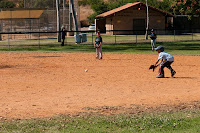
Turns out watching a bunch of really keen 6-8 year olds playing baseball rather badly is a pleasant and indeed mildly amusing way to spend a couple of hours on a Sunday afternoon. They are happy to make contact and chase behind the ball with abandon, but once they have the ball they often don't quite know what to do. It certainly helped that all the parents and coaches were really relaxed about the whole thing and were rather enjoying themselves as well. Abhi was a bit disappointed by the casual air and lack of professionalism - he commented to Malini that this was not like they play on TV. He had had high hopes - as we drove to the park, he asked, "Which stadium is Aeta going to play in?" No doubt expecting the answer to be something like Petco Park. Still he was excited to see Arjun play and as usual provided us with slow motion replays of what just happened on the field.
After the game I went up to the coach and inquired if we needed to get anything more than a glove. He was very complimentary of Arjun's efforts and commented that he couldn't believe that Arjun had never played before. Even without this my trepidation about Arjun's first little league game had long since eased - strangely, this had been at the back of mind ever since the ultrasound told us we were going to have a boy! But Arjun was a real gamer - he really wanted to play (he was the one who asked Malini to sign him up) and he didn't let anything bother him - the lack of equipment, being hit by balls, or being trussed up like a gladiator and asked to catch. Normally we have to drag him (sometimes kicking and screaming) for any extra curricular activities. This was clearly different. As he sleepily headed off to sleep, he said, "I can't wait for next Sunday so I can play baseball again."
Fighting my discomfort of such situations, I asked around and eventually found the coach. Pleasant fellow by the name of Matt. First thing I had to tell him was that Arjun has no glove and wondered if there was a spare one. None could be found immediately and Malini was almost heading to Target to buy one when another one of the parent coaches came by with a rather large one. Silly as it may sound, I didn't really know how to pull it on (a baseball fielder's glove is rather unique in that your hand only enters the lowest portion). Thankfully it was so big that Arjun was just able to put his hand into it. Then came the trickier part - catching with the glove. The kids were lined up in two groups and asked to throw to each other and sure enough, Arjun was having a hard time. He didn't know how to squeeze the ball and all he could try was to do a basket catch (essentially, you hold the glove face-up like a basket and hope that the ball lands inside and doesn't bounce out). Even this wasn't going too well and he got conked on his chin with a ball - no joke considering that they were playing with regular hard balls. However, it was soon obvious that most kids were pretty bad - even the well equipped ones - and I began to relax a bit. Still, I went up to Matt and told him that Arjun had never caught with a glove before. He was unfazed and said that he would spend some extra time with him.

Eventually all the practice time was over and it was time to play a real game. Coach announced the lineup and initial fielding positions (the kids would change during each inning) and Arjun seemed to be sidelined. And then it seemed like he was going to have really important position - catcher! The assistant coach started kitting him out with all the required padding and positioned him behind the hitter. Malini was uncertain what this move meant, but felt reassured that with all the padding he would at least be safe from the ball. The game started and Arjun's team (The Timber Rattlers) were fielding. Arjun was standing well behind the hitter, almost all the way to the back boards. There seemed to be no discernible purpose to having a catcher - all he did was to collect the passed balls and pile them up to be thrown back to the pitcher's mound. The whole outfit was a little constricting and severely hampered his mobility. Eventually, he got tired of standing and went into a crouch and looked a bit more like a regular catcher - not that he was doing any catching of course.
Then it was their turn to bat and they sent Arjun fourth or fifth. He was a bit tentative at first, but then all his baseball watching and playing with Abhi kicked in and he started making some good swings. Actually, to be accurate they were very good golf swings, but at his level it was just fine.
 He made good contact on one, but only succeeded in popping it up to the one kid who could actually catch. Still not too shabby.
The next inning he was fielding at third base and clearly getting more into the swing of things. When his turn came up to bat in the bottom of the second (the entire team gets to bat in each inning), he got his first ever hit
 and trotted happily to first base. And remarkably, this continued and he got a hit in every inning (going 4 for 5) and was rather decent in the field as well. Sure, he let the ball go through his legs when he was in right field (pretty much par for the course), but he also fielded a few balls cleanly and threw out a couple of runners.

Turns out watching a bunch of really keen 6-8 year olds playing baseball rather badly is a pleasant and indeed mildly amusing way to spend a couple of hours on a Sunday afternoon. They are happy to make contact and chase behind the ball with abandon, but once they have the ball they often don't quite know what to do. It certainly helped that all the parents and coaches were really relaxed about the whole thing and were rather enjoying themselves as well. Abhi was a bit disappointed by the casual air and lack of professionalism - he commented to Malini that this was not like they play on TV. He had had high hopes - as we drove to the park, he asked, "Which stadium is Aeta going to play in?" No doubt expecting the answer to be something like Petco Park. Still he was excited to see Arjun play and as usual provided us with slow motion replays of what just happened on the field.

After the game I went up to the coach and inquired if we needed to get anything more than a glove. He was very complimentary of Arjun's efforts and commented that he couldn't believe that Arjun had never played before. Even without this my trepidation about Arjun's first little league game had long since eased - strangely, this had been at the back of mind ever since the ultrasound told us we were going to have a boy! But Arjun was a real gamer - he really wanted to play (he was the one who asked Malini to sign him up) and he didn't let anything bother him - the lack of equipment, being hit by balls, or being trussed up like a gladiator and asked to catch. Normally we have to drag him (sometimes kicking and screaming) for any extra curricular activities. This was clearly different. As he sleepily headed off to sleep, he said, "I can't wait for next Sunday so I can play baseball again."
Tuesday, September 7, 2010
"Touching The Void"
Touching the Void is the story of a true life mountaineering adventure. In 1985, two young British climbers, Joe Simpson and Simon Yates made an attempt on the West face of the Siula Grande in the Peruvian Andes which was a route that had never been successfully climbed. The climb and the return journey have since become one of the most enduring tales of the mountaineering community.
The climb is challenging and dangerous, but they succeed in reaching the summit. However, as any mountaineer will tell you, reaching the summit is less than half the battle - most accidents and deaths happen on the way down. And it is no different for Simpson and Yates. Bad weather and poor planning has them in trouble right away, but disaster strikes when Simpson has a fall and breaks his right leg at the knee while they are still very high on the mountain. That is pretty much a death sentence and Simpson is almost resigned to it when they come up with a strategy of Yates lowering Simpson down the mountain in 300 foot sections. It is not easy, but they make progress until Simpson falls into a crevasse. Yates, who is sitting way above him on the mountain and supporting Simpson's weight has no way of telling what happened and eventually does the only thing he could practically do: cut the rope, causing Joe to fall further into the crevasse with no hope of climbing out with a broken leg and no food or water.
What follows is an astonishing tale of survival - both on the part of Simpson and Yates. It is also an examination of what really matters and the power of the mind over matter. Yates returned from the trip to a predictable storm of criticism over his decision to 'cut the rope' (and indeed, is still known as "The Guy Who Cut the Rope"), but Joe Simpson always defended him staunchly. He finally wrote this book in 1998, largely to defend his friend. The book is well written, but looking up mountaineering terms ahead of time (or keeping a dictionary handy) will make for easier reading.
Simpson and Yates returned to Peru in 2002 to film a documentary style recreation of their climb and far from being cathartic, Simpson had a terrible time during the filming and was later diagnosed to be suffering from Post Traumatic Stress Disorder (PTSD) - 17 years after his harrowing journey. The movie version is also to be recommended - it glosses over a number of details as all movie versions do, but the impact is more visceral and seeing the mountains and crevasse and hearing Joe and Simon talk gives it a great deal of verisimilitude.
Compelling and engrossing though the story is, we must accept that it is at best an ersatz experience for the lay reader - by Simpson's own account, he could not find the words to express the utter desolation of those 4 days on the Siula Grande.
Friday, August 20, 2010
Stieg Larsson & The Millenium Trilogy
They drink a lot of coffee in Sweden. Or at least that is the impression one is left with after reading the novels that make up the so-called 'Millenium Trilogy' by Stieg Larsson: "The Girl with the Dragon Tattoo", "The Girl Who played with Fire", and "The Girl Who Kicked the Hornet's Nest." These books, translated from the Swedish, have been runaway bestsellers and a worldwide publishing phenomenon. The third book in the series was released in May 2010 and together with the first two trace the story of Lisabeth Salander (the 'Girl'), who is, to put it mildly, a somewhat unique heroine in contemporary fiction: she is antisocial, covered with tattoos, an extremely talented computer hacker, bisexual, slight of physical stature, but a skilled boxer, and with her own sense of morality. However, the underlying theme is her fight against the establishment that victimized her early in life under the pretext of national security. Playing the male protagonist is Mikael Blomkvist, a slightly left leaning investigative journalist. He is also the co-founder of the magazine "Millenium" from which the trilogy takes its name. Mikael's character is not quite as complex as Salander's, but is nonetheless multifaceted and far from being flat.
The first book ("Dragon Tattoo") finds Blomkvist trying to solve a decades old missing person mystery that he eventually does with the assistance of Salander. The next two books focus more on Salander and the gradual unraveling of the conspiracy against her.
The stories are well plotted and despite their length (they average over 550 pages each) the reader's interest rarely flags. Most books of this genre resort to a cheap manipulation of the reader: manufacturing cliff hangers merely by switching the context. Larsson does none of this and I found that I really enjoyed reaching the end of a chapter with some kind of crisis situation and then have the scene continue at the start of the next chapter.
The real life back story to this trilogy is almost as interesting as the books themselves. The Blomkvist character is clearly meant to be a stand-in for Larsson himself (Larsson was a left leaning journalist who started and ran Expo, a magazine similar to Millenium) and some friends of Larsson have even suggested that parts of the Salander character may also be inspired by the author's own self. All three books were published posthumously: Larsson died in 2004 from a heart attack and the manuscripts for the books were discovered after his death. There is speculation that he never intended the books for publication and that he wrote them simply for his own pleasure. This in itself make these books intriguing as examples of works that were unaffected by commercial considerations or by the supervision of an editor. Incidentally, these are the only three fiction books published by Larsson. Supposedly he left behind some more incomplete manuscripts and outlines, but much of that is the subject of much wrangling between his heirs and long time girlfriend. A side effect of the success of these books has been a renewed interest in foreign authors - publishers have been scouring the best seller lists of countries around the world in a bid to find the next Stieg Larsson.
As mentioned earlier, a lot of coffee is drunk by the characters in these books (it is a wonder any of them are able to sleep at all). There is also lots of detail about towns in Sweden and in particular lots of mention of place names and road names, most of which I could not pronounce. After a while, one tends to glaze over these names, but as might be expected you don't really lose much by doing so. Despite the translation, a sense of the place and people does come through - the echoes from the Wallander books or even Smilla's Sense of Snow are faintly evident.
All three books have been made into movies in Sweden and they have all received strong reviews. The first one has already has already made it to the US (in fact playing in San Diego now) and others should follow. Overall, an entertaining set of books that comes with a glimpse into a slice of Swedish society and life.
Thursday, August 5, 2010
Cycling, Lance, Baseball, & Doping
The Tour de France (TDF) is arguably the most difficult endurance contest in the world and only five men have won it five times and only one - Lance Armstrong - has won it more than five times. His record tying fifth victory was in 2003 and questions and doubts swirled around the possibility of Armstrong becoming the first ever to win six (he would go on to win 7). Several of the previous 5-time winners had stumbled while trying to win one more. In Lance Armstrong's War, Daniel Coyle gives a superbly detailed account of Armstrong's 2004 campaign. The book was published in 2005, but I just read it - with the recently concluded 2010 TDF whetting my appetite for related stories. You don't just show up in July and try to ride in the tour - the preparation starts many months before and that is where Coyle starts as well. He is there for every training race, every experimental bike, and seemingly around every conversation that goes on between Armstrong and his team. Pro-cycling has more than its share of colorful characters and Coyle profiles a number of the key cyclists who had a legitimate chance of winning in 2004 - Jan Ullrich, Tyler Hamilton, and Iban Mayo among others. Making several cameo appearances is 'Juanita Cuervo' (aka Sheryl Crow), who Armstrong was dating at that time. Even though we know how the race ends, Coyle succeeds in building up the anticipation and his blow-by-blow account of key stages of the 2004 race is rather satisfying. The time elapsed since the race helps no doubt, although in my case that is moot since I had not followed the race very closely back in '04. Just as much as an account of the race, the book is an attempt to explain the enigma that is Lance Armstrong. He is not an easy person to know or get close to. With his emphatic victories and inspirational cancer survivor story, he is a sports icon without peer, certainly within the American landscape. He has many detractors of course and indeed there were even threats made on his life during the penultimate stage in 2004 and he had to be protected by armed guards during the actual race.
One question that has dogged Armstrong throughout is the accusation of cheating/doping - the use of performance enhancement drugs. Armstrong does have certain physiological advantages (Coyle explains the science behind his ability to operate at peak performance without going into the anaerobic zone longer than anybody else), but his dominating performances and take-no-prisoners attitude has spawned lots of doubters. The official record is that he has never tested positive, but that hasn't stopped the questions. And there is plenty of circumstantial evidence. The conventional wisdom about doping in pro-cycling is that everybody does it, so what is the big deal. Several of his accusers (among others, a massage therapist in his employ, his old mechanic, and Floyd Landis, his old teammate and the cyclist who was stripped of the 2006 TDF title after testing positive) have provided very detailed descriptions of how Armstrong apparently cheated over the years (none of which have been independently corroborated as of date). Although, Steven Levitt (of Freakonmics fame) has argued in a blog that the very specificity of the accusations is proof enough of their truthfulness. Freakonomics was persuasive, but this particular one argument does not wash with me - perhaps I am too much of a Lance Armstrong fan and don't really want to believe. The book is aptly titled: Everything is a 'war' for Lance Armstrong and it continues to this day - even as he was finishing off his last tour, investigations based on Landis' claims and others were just getting underway.
Coyle is clearly interested in being the objective reporter and his book comes across as neither a hatchet job nor hagiography. It is a fascinating glimpse, albeit fleeting, into a world that many of us will never get close to and I highly recommend it.
Doping was rampant in procycling in most of the 90s and the 2000s and the case was no different in another sport in which fair play and chivalry are held paramount - baseball. The rather surprising fact about pro-baseball is that many of the drugs that were banned in other sports were not actually illegal in baseball till very recently. During the last decade and a half the power numbers have been off the charts (basically the batters have been doing very well)and this surge crystallized in the single-season home run record chase of 1998 and culminated with Barry Bonds going past Hank Aaron's all-time home run record (755) - a record that was essentially considered unreachable just a few years ago. However, the home run kings of the last decade or so have mostly been discredited, almost to a man and even Congress has held hearings on this topic. All of this hue and cry may be having an effect: While the single season home run record is now 73 and the top hitters were routinely getting 40-50 homers, this year nobody even has 30 and there is less than a quarter of the season left. Ostensibly, a similar effect can be seen in the TDF - not a single rider tested positive in the last two years, but curiously performances have not really dropped. It is hard to believe that the tour has suddenly become clean, especially when winners of other major cycling races continue to test positive every so often.
Of course, doping is no longer limited to the realm of sports - it is becoming more common place for students to boost their academic performance by improving their focus and concentration by illegally using drugs typically prescribed for ADHD. Next surely, will be genetic engineering. Rather depressing to contemplate, to say the least. But then I wonder, how different are these "aids" from that of the more affluent parents resorting to private schools, extra coaching, and donations to further their child's academic careers?
Wednesday, August 4, 2010
Dream Layers
I swear I am not making this up. I don't have dreams that often (or at least ones that I can recall the next morning), but lately I have been having a few that seem to involve playing baseball, but with a random set of rules. And apparently this is after I had joined the army. As if this wasn't strange enough, last night really upped the ante.
It started off with the usual baseball-with-strange-rules (this is not that unexpected since the boys and I play a mini baseball game indoors on a regular basis). Then I am driving away from the game and the boys are with me and suddenly I realize that we had left Malini behind. So I whip the car around real fast and end up climbing the curb. As I speed away, I think I hit somebody. I stop and come back, but in the gathering dark, there is nobody to be seen. I am rather shaken as I make my way back to the field only to see Malini waiting, totally relaxed - like I had never left. And the boys are with her. I turn around and sure enough, the boys are not in the car. I realize with a start that the whole driving away had only been a dream. Malini and the boys climb in and we start driving away and all of sudden I don't recognize where I am - somewhere on the east coast, maybe? Oh no, this had been another dream! I am immediately aware that I have just experienced a dream-within-a-dream and start describing this to Malini and realize that she is no longer there. I feel a sense of discomfort (wanted to pee, no doubt) and open my eyes and now I am finally in familiar environs - in our bedroom with Malini curled up next to me. And it dawns on me that I had just experienced a third layer of dreaming. Fortunately that was the end - I fell back into a deep sleep and had almost forgotten about this until just now. What was striking was the strong feeling that I was popping up a 'level' each time I realized that I was in a dream. Maybe there is something to this Inception business? Or maybe, somebody wants me to believe in the premise of the movie and is trying to plant the idea in my head....?
It started off with the usual baseball-with-strange-rules (this is not that unexpected since the boys and I play a mini baseball game indoors on a regular basis). Then I am driving away from the game and the boys are with me and suddenly I realize that we had left Malini behind. So I whip the car around real fast and end up climbing the curb. As I speed away, I think I hit somebody. I stop and come back, but in the gathering dark, there is nobody to be seen. I am rather shaken as I make my way back to the field only to see Malini waiting, totally relaxed - like I had never left. And the boys are with her. I turn around and sure enough, the boys are not in the car. I realize with a start that the whole driving away had only been a dream. Malini and the boys climb in and we start driving away and all of sudden I don't recognize where I am - somewhere on the east coast, maybe? Oh no, this had been another dream! I am immediately aware that I have just experienced a dream-within-a-dream and start describing this to Malini and realize that she is no longer there. I feel a sense of discomfort (wanted to pee, no doubt) and open my eyes and now I am finally in familiar environs - in our bedroom with Malini curled up next to me. And it dawns on me that I had just experienced a third layer of dreaming. Fortunately that was the end - I fell back into a deep sleep and had almost forgotten about this until just now. What was striking was the strong feeling that I was popping up a 'level' each time I realized that I was in a dream. Maybe there is something to this Inception business? Or maybe, somebody wants me to believe in the premise of the movie and is trying to plant the idea in my head....?
Subscribe to:
Posts (Atom)
-
First, the good news: the 2024 March primaries do not feature a Prop related to dialysis clinics. This can't last of course, but let...
-
 The outing was taking longer than expected. It was the penultimate day of our short trip to Japan and Prem, Malini, and I had left early fo...
-
Most mornings, I drop Arjun off in a cul-de-sac from where he can walk down to his school. This is a very popular drop-off area ...